
Launching orbital data centers is like asteroid mining in reverse
How much e-waste material would be lost by putting AI data center servers in space, instead of a building where they can easily be collected and recycled?


In my last story, I looked at Elon Musk's proposal to maintain a million AI data center satellites in orbit. Specifically, I covered recent research related to what might happen when many thousands of those satellites burned up in the atmosphere each year, depleting an unknown amount of ozone.
But apart from the potential environmental impact of launch and reentry emissions, the idea also has an obvious sustainability downside. Whether the satellites are burned up in the atmosphere or moved into a distant "graveyard" orbit, they definitely aren't being recycled. So how much e-waste would be lost by putting data center compute in space, instead of a building where it can easily be collected at end of life?
Reduce, reuse, yeetcycle
SpaceX's website touts improved access to solar power as one justification for launching data centers into orbit, noting that "it's always sunny in space." (Solar panels can also be used here on Earth, though Musk's Colossus 2 data center in Tennessee has been running on 59 unpermitted natural gas generators, instead.)
But the primary explanation has been (somewhat incredibly) cost. "My estimate is that within 2 to 3 years, the lowest cost way to generate AI compute will be in space," Musk wrote. One aspect of that analysis is surely the complete absence of environmental regulations—though if terrestrial data centers were also closed loops that generated their own power and cooled their chips without drawing any water resources, environmental regulations wouldn't be much of an issue.
But obviously we wouldn't get any orbital equipment back, and data centers (satellite or no) contain a lot of valuable materials. That includes some that are pretty expensive to source from mining because they aren't abundant, such as silver, gold, bismuth, and palladium.
So in a way, this is the opposite of asteroid mining—something SpaceX listed as a future market in its May IPO filing—since it exports minerals to space. (Or just disperses them throughout the atmosphere, which is more like a worst possible version of landfilling e-waste, to be fair.)
Running the numbers
In my first story, I worked out the fate of satellites dying each year based on SpaceX's FCC filing. We're talking about 200,000 satellites being retired annually, with somewhere between 0 and 160,000 pushing out to a graveyard orbit and the remainder burning up on atmospheric reentry. For the purposes of this estimate, we'll just focus on the fact that 200,000 are disposed of without recycling.
SpaceX's "AI1" satellites do not actually exist, so there's no way to know exactly what they would contain. But Musk did say each one would be the equivalent of an NVIDIA B300 rack, with 72 GPUs. We'll just work with that and set aside the other server components, power system (including solar panels), and huge cooling system.
Now NVIDIA's B300 "Blackwell" GPUs are also new and the details we need are scarce. But a study published in May included a full chemical analysis of NVIDIA's earlier A100 GPU. The B300 seems physically larger than an A100, with about double the silicon die area and 7 times as much RAM, for example, but we'll use the A100 analysis for a conservative estimate of the contents of the 72 GPUs aboard each satellite. Because they would be liquid cooled rather than air cooled on the satellite—and that hardware could take a lot of forms—I'll even remove the copper heatsink from the math, which accounted for about 88% of the total mass of the A100 card that was analyzed.
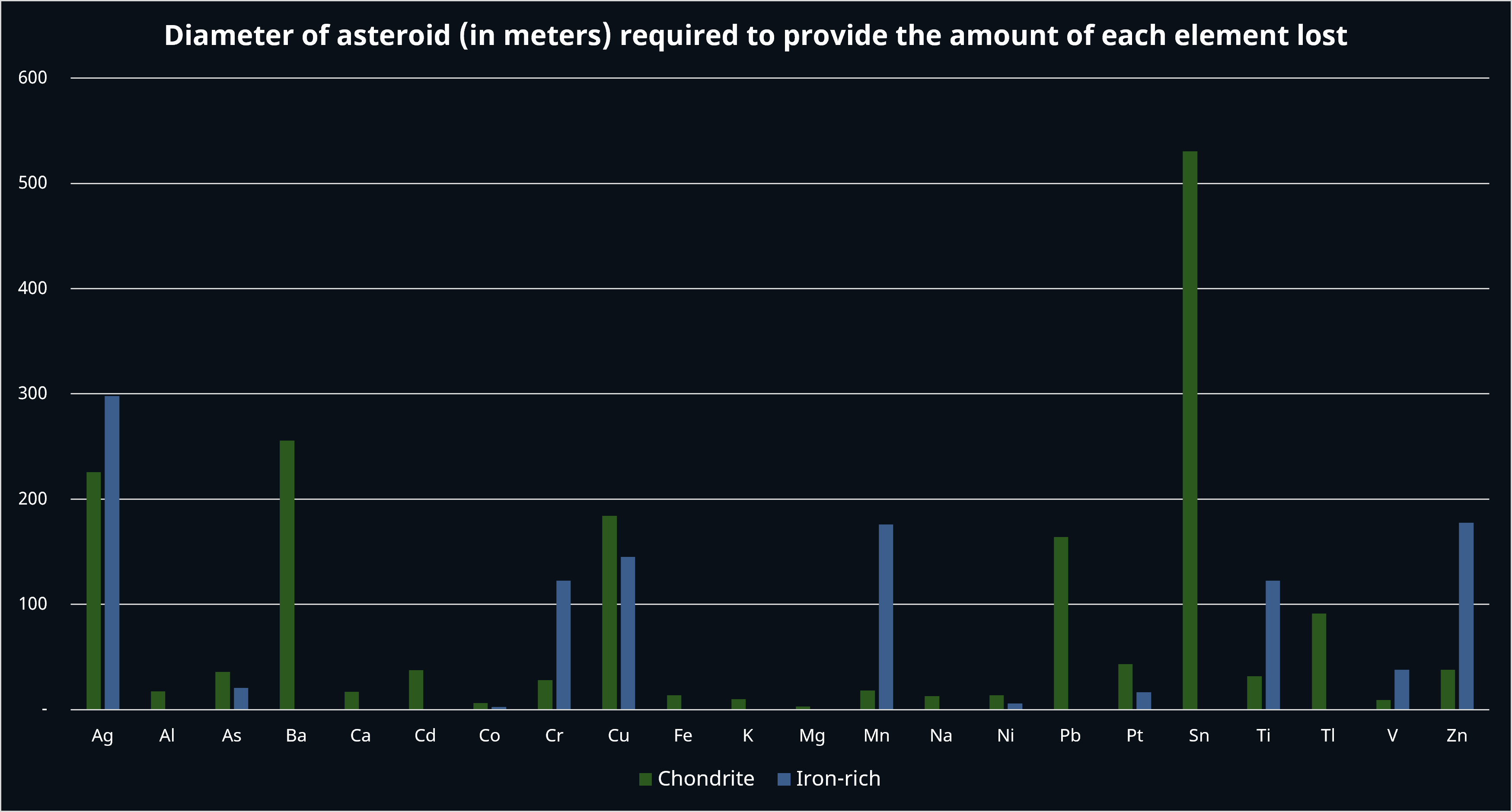
Then comes the fun part: We can compare the total amount of each element to the composition of asteroids to figure out how large of an asteroid would have to be mined to recover the minerals lost in those GPUs. I'll even use two types of asteroid, so don't come after me for ignoring your favorite. Carbonaceous chondrites (using numbers for the CM group and a density of 2.2 g/cm3, specifically) account for most asteroids out there. I'll also repeat the math for the rarer iron-rich M-type asteroids, using a density of 4.2 g/cm3.
Even just accounting for the GPUs—and again, using a conservative example and ignoring its heatsink—onboard 200,000 satellites lost every single year, the numbers add up. We're talking about roughly 1,700 kg of silver, 72 tons of aluminum, 1,000 tons of copper, 2 tons of palladium, 160 tons of tin, and 20 tons of titanium, for a few examples.
The abundance of each element is different in asteroids, so the size of asteroid needed to produce those amounts varies. I'll give two examples and let you look at the chart for the rest. To recover that much titanium, you'd need a (spherical) chondrite asteroid about 30 meters in diameter, or a 120 meter iron-rich asteroid. To mine that much copper, you'd need to consume a 145-185 meter asteroid. (If we had included the mostly-copper heatsink, that would increase to 400-500 meters.)
And that's per year.
Circularity isn't just an orbit over Egypt
Back on Earth, e-waste is enough of a problem. A recent UN report estimated that 62 million metric tons were produced globally in 2022, only 22% of which was collected and properly recycled. The AI1 satellite numbers certainly aren't enough to shift the global e-waste math, but it is unique that we're talking about e-waste being ejected into space or dispersed throughout the atmosphere—so a 0% recycling rate with a pretty weird asterisk.
Comparing this to asteroid mining isn't just about Elon Musk's insistence that both are critically important to humanity. Because there is apparently a rule that this orbital data center idea has to continually get more preposterous, Musk told shareholders on SpaceX's first earnings call August 4 that he wants to save on launch costs by building AI1 satellites on the Moon from materials mined there by robots.
I'll give you a moment to read that sentence again.
So far in my napkin-math analysis, I've glossed over what it means to actually recover native elements from the materials present in an asteroid. Musk did, too, when he said on the call that the lunar regolith could be a source of materials like aluminum and titanium.
The Moon's surface rock, and therefore its loose regolith, is composed of basalts and other igneous rocks. Most of these rocks aren't considered ores on Earth, where they are also quite common. Ores generally involve some kind of selective mobilization process that conveniently concentrates the elements you're after. It's pretty hard for production to be economically viable without that step—and that's without off-worlding your operation to a Moon base that makes Antarctica look like a Costco.
Titanium might be a relatively tractable resource to mine on the Moon, and sure, it's possible to extract aluminum, but most materials would either require a heinous amount of energy to extract or are too rare to bother trying. The prospect of lunar mining is usually focused on doing whatever it takes to make a lunar base self-sustaining, not on moving your manufacturing up there in a quest to save a buck.
At some point, there would have to be an evaluation of whether all this—mining the Moon to shoot its minerals into space—is worth it to avoid putting some more slop-flyer-generating servers in normal data centers. The fate (and if we're extremely generous in humoring Musk's fantastical claims, the source) of the materials involved would be part of that calculus.
That said, the eye-wateringincinerating cost of this scheme may very well eliminate the need to ever analyze it in too much detail. Normally, environmental problems are ignored because of the profit, not despite there being no prospect of ever turning one. The math of environmental sustainability is unforgiving, and so is the math of paying to keep a million GPU racks orbiting the Earth.